You know that building a successful software product isn't just about speed. It is fundamentally about eliminating risk in the correct sequence.
And in that process, most startups don't fail because engineers couldn't write the code. They fail because they built the wrong feature, launched too early, or targeted a non-existent market.
The debate around Prototype vs PoC vs MVP often gets lost in boardrooms, leading teams to treat these distinct milestones as interchangeable. Doing so is an expensive mistake that drains runway and stalls momentum.
PoC (Proof of Concept) validates technical feasibility by answering whether the product can be built. A Prototype validates the user experience and workflow by showing how the product will feel and function. An MVP (Minimum Viable Product) validates market demand by determining whether users will pay for it. The strategy is to identify the highest area of risk first and then build the corresponding asset to eliminate that risk systematically.
Why Product Validation Strategy Determines Startup Survival
The truth of modern software development is stark: 43% of startups fail primarily because of a lack of product-market fit, building features or whole products that no real user actually wants or is willing to pay for.
Every product idea carries three core categories of risk: technical feasibility, usability, and market demand. Attempting to solve all three simultaneously creates a messy product scope, inflates burn rates, and delays launch dates.
Understanding where your product sits within the product development lifecycle saves time and capital. Here is how these three validation assets compare across key operational dimensions:
Proof of Concept: Validating Technical Feasibility
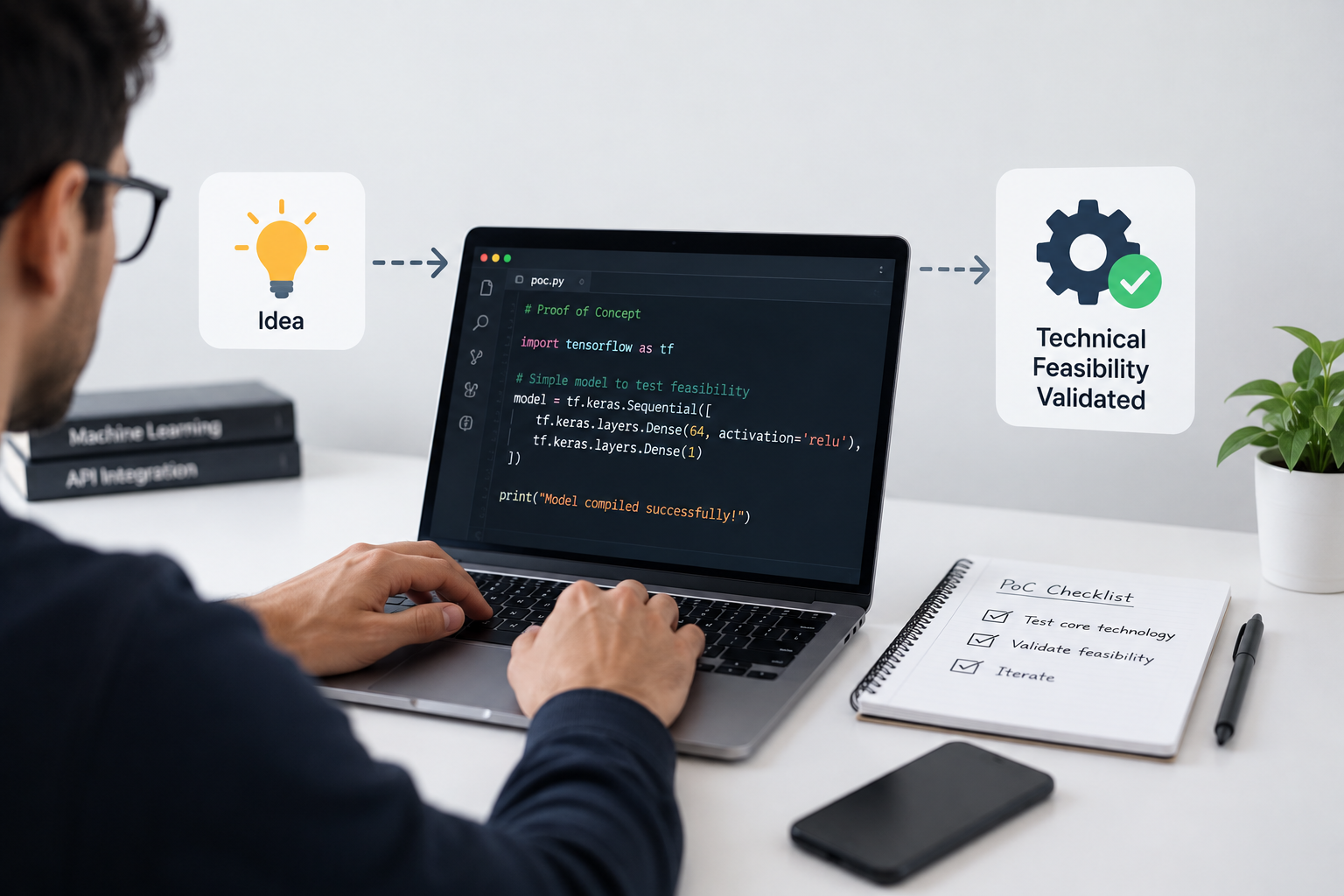
A Proof of Concept is a raw, internal exercise designed to verify whether a core technology can actually be realized. It isn't built to look sleek, handle edge cases, or support thousands of concurrent users.
Instead, a PoC focuses entirely on technical feasibility testing to prove that an unproven concept works under isolated conditions.
When to Build a PoC
- Your product relies on a novel algorithm or machine learning model.
- You need complex hardware integrations or unproven API synchronizations.
- You are attempting a technical architecture that lacks industry benchmarks.
Real-World Example
If you are developing an AI tool, your PoC shouldn't include user authentication, billing platforms, or dashboard design.
It should be a single backend script testing whether the model processes medical images with acceptable accuracy.
Prototype: Mapping the User Experience
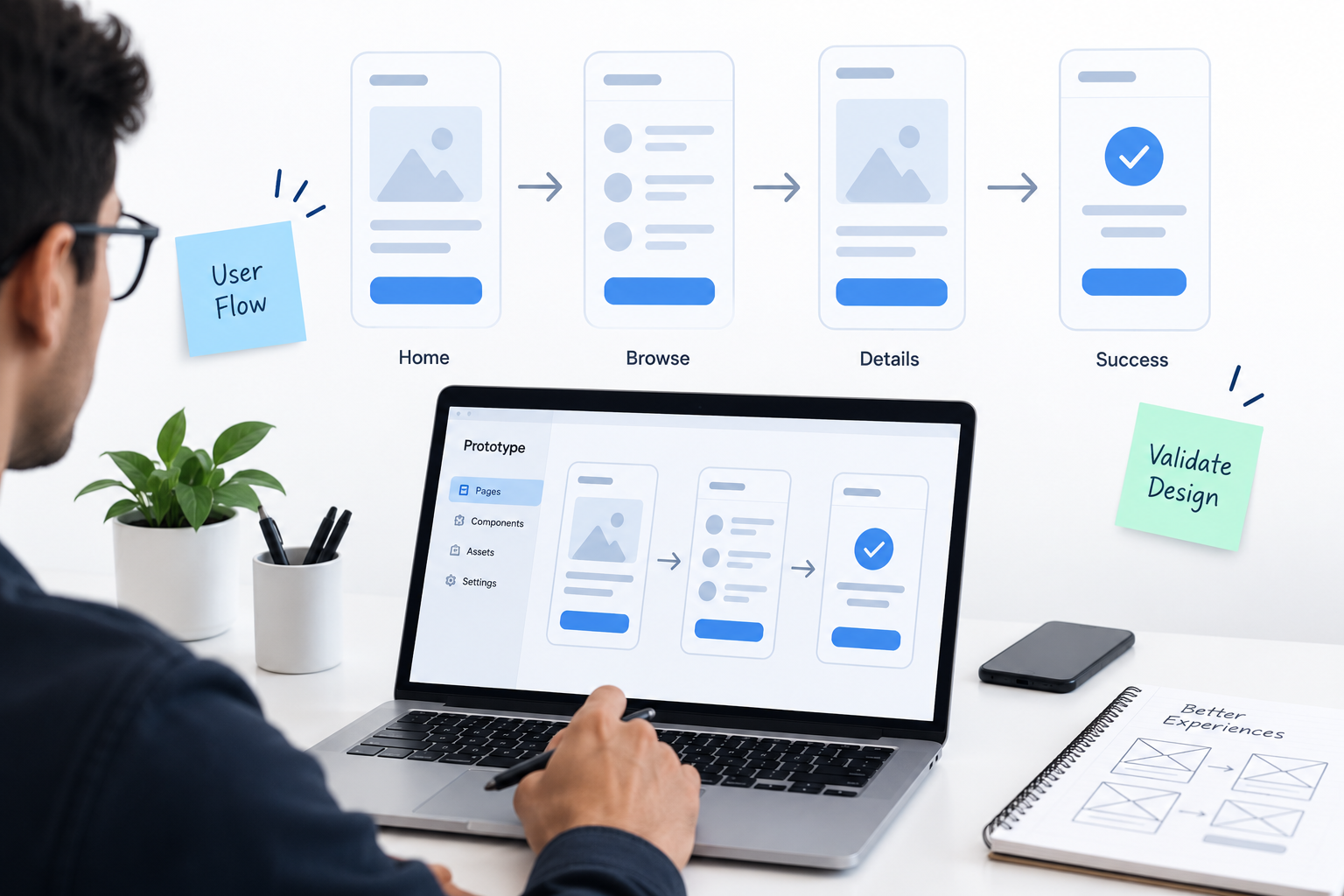
Once technical feasibility is verified, you must establish how the product feels and functions. A Prototype changes abstract concepts into visual, interactive representations without backend infrastructure.
Through effective wireframing, a prototype maps out critical user flows. It gives stakeholders a tangible asset to evaluate navigation, layout, and functional hierarchy.
When to Build a Prototype
- You need to test navigation intuitiveness with actual target users.
- You are pitching early-stage investors to secure seed funding.
- You need alignment among internal product design teams before writing code.
By deploying interactive wireframes during initial user testing, you can adjust workflows in minutes. Fixing user experience flaws in design software costs a fraction of refactoring live production code.
Minimum Viable Product: Testing Market Reality
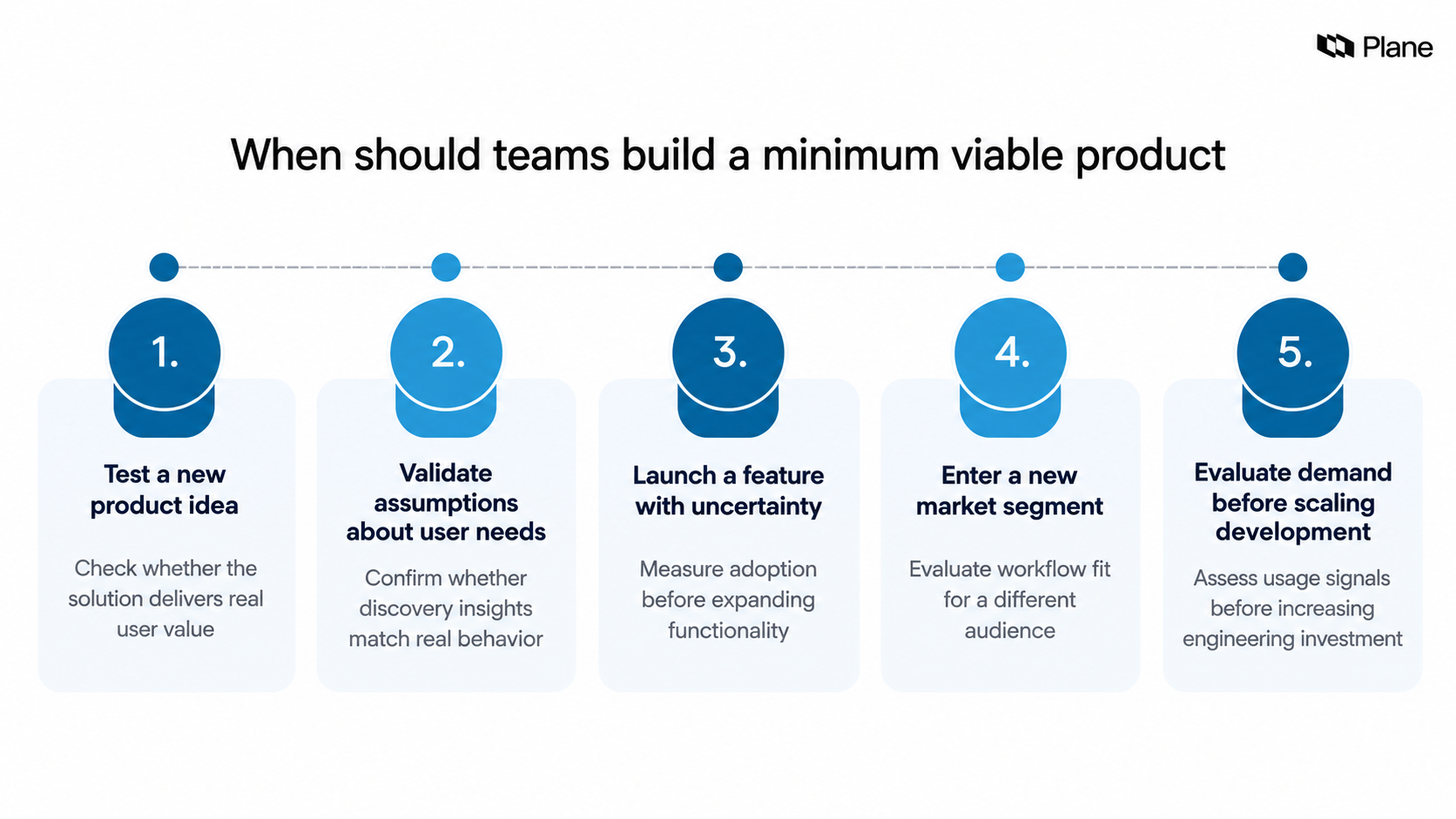
An MVP is the first functional version of your product deployed to real users. It contains just enough core functionality to solve a primary problem while capturing real-world usage metrics.
Executing an intentional MVP development strategy helps you transition from internal hypotheses to validated market learning.
Key Elements of a Successful MVP
- Stable Infrastructure: Secure, functional software capable of real data processing.
- Core Value Focus: Solves one specific problem exceptionally well without extra bloat.
- Feedback Loops: Analytics and telemetry built-in to monitor user behavior and retention.
Real-World Example
When Airbnb launched, it didn't build automated payments, interactive maps, or robust review systems. The founders launched a simple web page listing an air mattress in their apartment. This minimal setup successfully proved market demand: people were willing to pay to sleep in a stranger's home.
The Costly Pitfalls of Stage-Jumping
Skipping structural stages in product development compounds technical debt and inflates burn rates:
- Building an MVP without a PoC: You spend months coding authentication, payments, and account dashboards, only to realize the core algorithm cannot process data efficiently.
- Building an MVP without a Prototype: You launch functional software, but users churn quickly due to confusing navigation and awkward onboarding flows.
- Over-engineering the MVP: Adding "nice-to-have" features turns a lean launch into a bloated software release, delaying valuable market feedback.
Decision Framework: What Should You Build First?
| Strategy | When to Choose | Core Action Items |
|---|---|---|
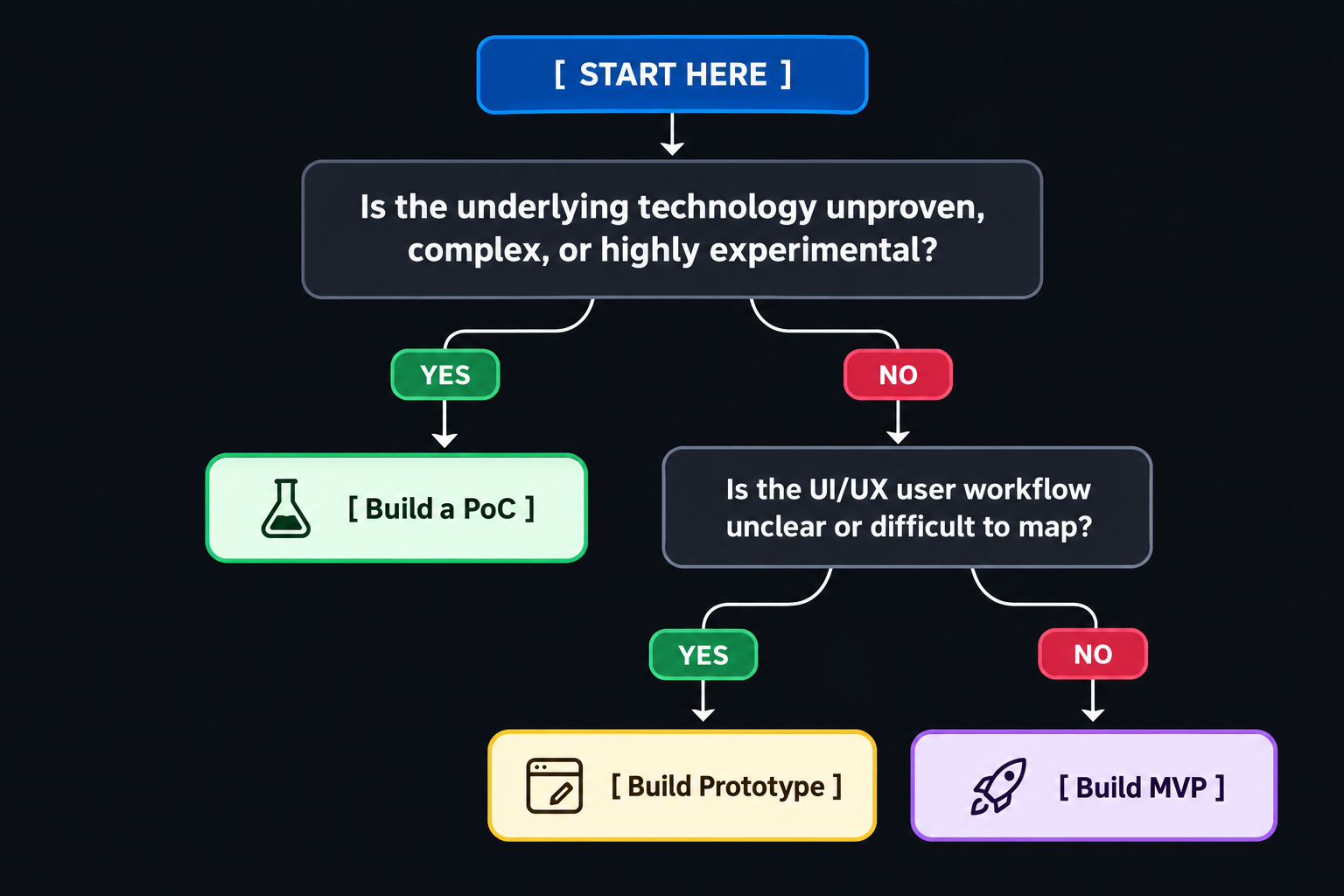
| Proof of Concept | High Technical Risk — your business depends on complex processing or custom software logic. | Clear all technical roadblocks before investing in design systems or marketing assets. |
| Prototype | High Usability Risk — your tech stack is standard but introduces a novel user workflow. | Build an interactive Prototype and test Figma screens with target users to refine navigation quickly. |
| MVP | High Market Risk — the technology is standard and the workflow is intuitive, so market indifference is the real threat. | Deploy a lean MVP to measure real retention, conversion, and demand. |
Comparing PoC, Prototype, and MVP
Here is how these three validation assets compare across key operational dimensions.
| Dimension | Proof of Concept (PoC) | Prototype | Minimum Viable Product (MVP) |
|---|---|---|---|
| Core Question | "Can this actually work?" | "How will users interact with it?" | "Will the market pay or adopt this?" |
| Primary Goal | Validate technical feasibility | Validate usability & workflow | Validate market demand & value |
| Target Audience | Internal team, R&D, CTO | Designers, internal leads, test users | Early adopters, real market users |
| Production Level | Throwaway code, hardcoded logic | Interactive wireframes/mockups | Functional software with real backend |
| Lifespan | Discarded after verification | Iterated into design systems | Evolved into the scalable product |
Step-by-Step Guide to Executing Your Build Order
Isolate Your Greatest Uncertainty
Determine whether your primary risk is technical feasibility, user experience design, or market demand.
Build the Smallest Verification Artifact
Develop the simplest tool required to test that specific risk area — a script for technical risk, wireframes for usability, or an MVP for market demand.
Measure Specific Quantitative KPIs
Set clear benchmarks, such as algorithm accuracy rates, task completion speed, or user retention metrics.
Iterate or Transition
Use direct feedback to refine your product before advancing to the next stage of development.
Aligning Strategy with Execution
Understanding the real nuances of Prototype vs PoC vs MVP allows product leaders to allocate capital efficiently, de-risk development, and accelerate time-to-market. A PoC proves whether it can be built, a Prototype proves how it should be designed, and an MVP proves whether it must exist in the market. Matching your development output to your operational risk protects your runway and yields scalable software users actually want.
Build the Right Product at the Right Stage
Not sure whether you need a PoC, Prototype, or MVP? GStar helps you identify the highest-risk assumptions, choose the right validation milestone, and build a focused product strategy that protects your capital and accelerates your launch.