Every product leader faces a critical architectural decision before writing a line of code: Should you build a native app or opt for a cross-platform approach?
Choosing the wrong architecture can drain your budget, delay your go-to-market speed by months, and create friction as your user base expands. This guide breaks down the financial, technical, and operational tradeoffs so you can select the right strategy for your mobile roadmap.
Choose Native if you are building graphic-intensive, compute-heavy, or hardware-centric apps requiring maximum speed and native execution. Choose Cross-Platform if you need rapid market entry, a shared codebase, and cost-effective development for standard business applications.
What Is Native vs Cross-Platform App Development?
Understanding the technical foundation of each approach helps clarify its real-world trade-offs.
Native App Development
Native development involves building dedicated applications for specific operating systems using platform-exclusive SDKs and languages:
- iOS: Swift or Objective-C via Xcode
- Android: Kotlin or Java via Android Studio
Because native code interacts directly with the OS without an intermediate layer, it offers unrestricted access to underlying hardware components such as the GPU, Bluetooth, GPS, and onboard sensors.
Cross-Platform App Development
Cross-platform development uses a single codebase to target both iOS and Android simultaneously, streamlining your mobile development workflow. Modern frameworks compile into native components or render unified UI elements across platforms.
Leading Frameworks: React Native, Flutter, and .NET MAUI.
By sharing 70% to 95% of core business logic, a cross-platform architecture streamlines initial builds and reduces engineering overhead.
Initial Investment vs. Total Cost of Ownership

Initial build estimates rarely reflect the full financial picture. Evaluating the 3-to-5-year Total Cost of Ownership (TCO) reveals distinct cost trajectories for each path.
| Expense Category | Native Development (iOS + Android) | Cross-Platform (Single Codebase) |
|---|---|---|
| Initial Launch Budget | High ($$$$$) — Requires dual teams | Moderate ($$$) — Shared engineering |
| Go-To-Market Speed | Standard baseline | 30%-50% faster deployment |
| Long-Term Maintenance | Predictable, platform-aligned updates | Lower routine effort; complex framework upgrades |
Speed to Market and Development Costs
Building a single codebase using a cross-platform stack allows one unified team to deploy across both major app stores at once. This significantly lowers early engineering costs and accelerates product launches.
Conversely, native projects require two independent development pipelines. Design adaptations, feature implementations, and QA testing cycles must occur twice, effectively doubling early labor requirements.
Lifecycle Maintenance and Upgrades
Routine maintenance for cross-platform apps remains cost-effective because bug fixes apply across both platforms simultaneously. However, when major OS versions launch, teams must wait for community plugins or third-party bridges to update, or write custom native modules in-house.
Native apps avoid intermediate framework dependencies entirely, providing long-term predictability during OS transitions.
Performance: Execution Speed, Graphics, and Hardware
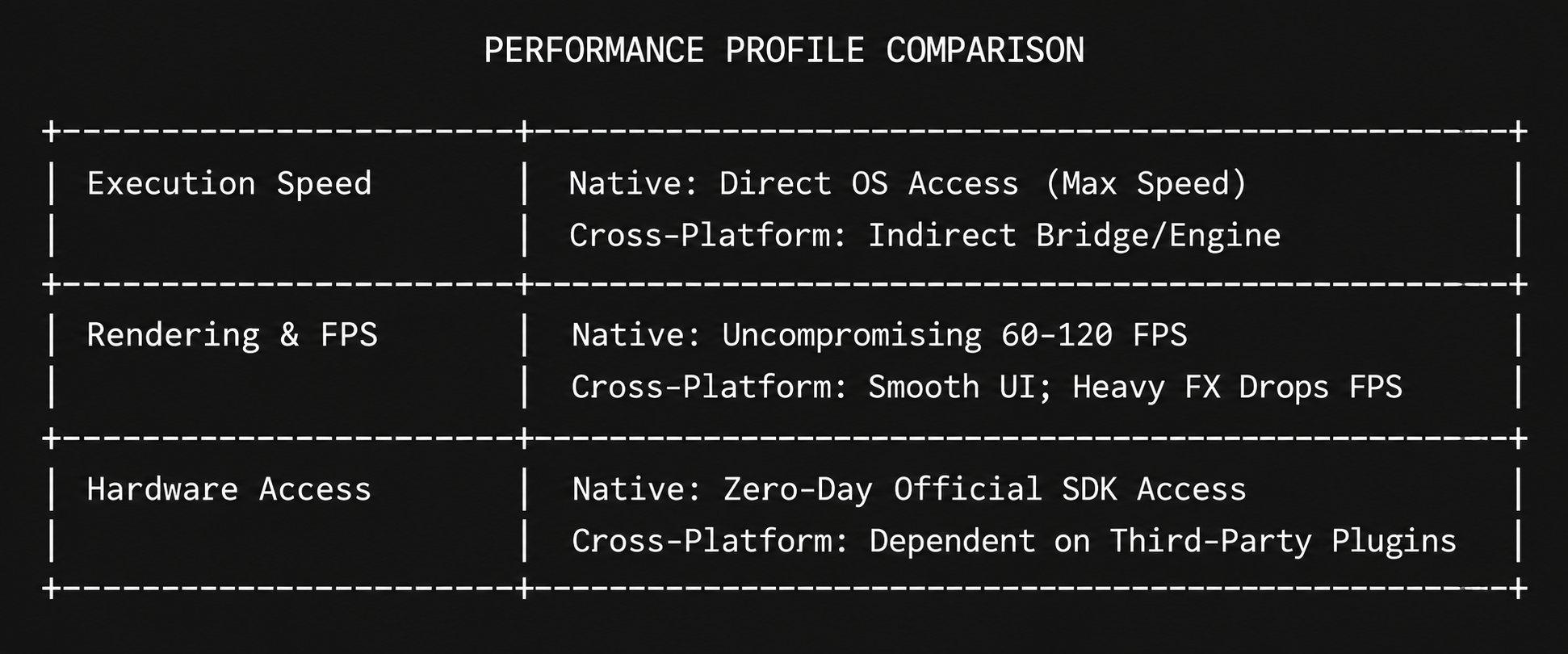
App performance directly affects user retention. Micro-stutters or elevated battery consumption can quickly lead to negative reviews and lower ratings.
Processing Power and UI Rendering
Native software compiles straight into machine code, allowing graphic-heavy applications, AR/VR experiences, and complex mathematical calculations to run smoothly at 60 to 120 FPS.
Modern frameworks like Flutter (compiling to native ARM) and React Native (using the Fabric renderer) offer excellent performance for roughly 85% of standard applications, such as e-commerce apps, SaaS dashboards, and content platforms. However, resource-heavy operations can still cause frame drops or higher CPU usage.
Hardware Access and OS Updates
Native developers gain immediate access to newly announced iOS and Android platform APIs on day one. Cross-platform builds often rely on open-source plugins, which can introduce delays when leveraging specialized hardware features or recent system updates.
Mobile App Scalability and Architectural Longevity
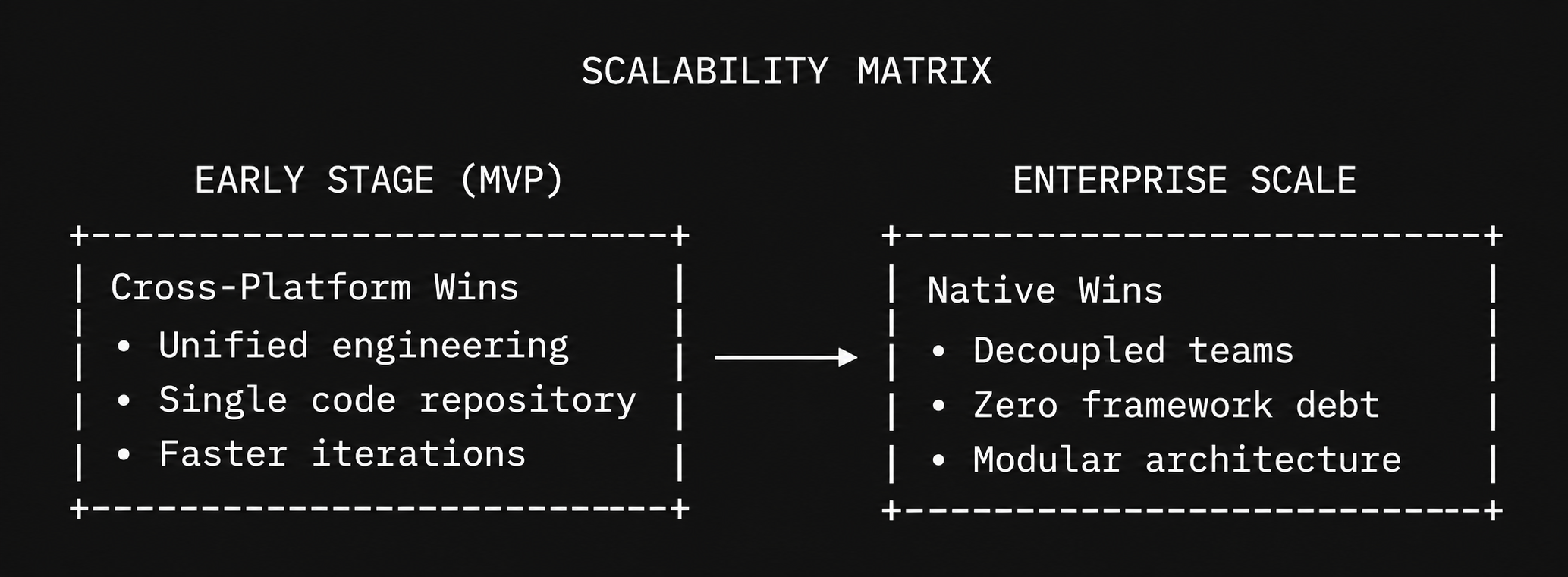
Long-term mobile app scalability involves expanding your features and codebase without accumulating technical debt.
Team Structure and Codebase Maintenance
Early-stage cross-platform builds scale rapidly because a single team manages the entire feature set. As functional requirements grow more complex, edge cases may demand native specialization to manage custom platform integrations.
Native applications follow standardized architectural guidelines established by Apple and Google. Decoupled iOS and Android codebases allow large engineering departments to scale independently without worrying about breaking changes in third-party frameworks.
Framework Stability
Native platforms benefit from direct, perpetual support from Apple and Google. Cross-platform projects depend on the ecosystem surrounding their framework. If an underlying tool loses community traction or undergoes major refactoring, long-term updates can become costly.
Quick Comparison
A fast reference for matching your framework choice to what matters most for your product.
| Priority | Best Fit: Native | Best Fit: Cross-Platform |
|---|---|---|
| Budget | Higher upfront, dual engineering teams | Lower upfront, one shared team |
| Speed to Launch | Standard baseline timeline | 30%-50% faster deployment |
| Graphics & Hardware | AR/VR, GPU-heavy, sensor-dependent apps | Standard UI, moderate interactivity |
| Scalability Style | Independent platform teams at scale | Single team managing shared logic |
| Best For | High-performance or hardware-centric apps | MVPs and standard business apps |
How to Choose the Best Framework Strategy
Use this step-by-step decision framework to evaluate your project requirements against your business goals.
Assess Core App Capabilities
Evaluate processing and hardware requirements. Determine if your app relies heavily on real-time rendering, background processing, AR/VR, or specialized hardware connections (like IoT/Bluetooth). If yes, select Native.
Evaluate Budget and Launch Timeline
Align capital with market entry speed. If your priority is validating an MVP, lowering initial capital expenditure, or launching on both platforms simultaneously within tight deadlines, select Cross-Platform.
Determine Long-Term Maintenance Capacity
Plan for ongoing engineering needs. Consider whether you can sustain two dedicated engineering streams over time. If long-term architectural autonomy and day-one OS API access are critical, invest in Native.
Next Steps for Your Product Strategy
Choosing between native and cross-platform architecture shapes your product's entire roadmap. Align your choice with your immediate budget, technical requirements, and long-term growth strategy. Need help choosing the right tech stack for your app?
- For MVPs and standard business apps: Start with a cross-platform framework to validate your product quickly and conserve capital.
- For high-performance or hardware-focused apps: Invest in native development from day one to deliver an uncompromised user experience.
Frequently Asked Questions
Is cross-platform development cheaper than native development?
Yes, initial development costs for cross-platform apps are generally 30% to 50% lower because a single team writes and maintains one shared codebase for both platforms.
Which cross-platform framework performs best for mobile apps?
Flutter and React Native are widely considered top options. Flutter excels in consistent UI rendering via its graphics engine, while React Native provides a near-native feel using native UI bridges.
Can a cross-platform app scale to millions of users?
Yes, major global applications like Instagram and Skype successfully run cross-platform components at scale. The key is ensuring complex native integrations are properly modularized as features expand.
When should a business choose native over cross-platform?
Native development is ideal when building resource-intensive software, complex 3D/AR interfaces, IoT integrations, or enterprise platforms that demand long-term stability and immediate access to new OS features.
Need Help Choosing the Right Tech Stack for Your App?
Our product strategists evaluate your performance, budget, and scalability needs to recommend the right native or cross-platform path, then build it.